25.10. – 17.11 2024
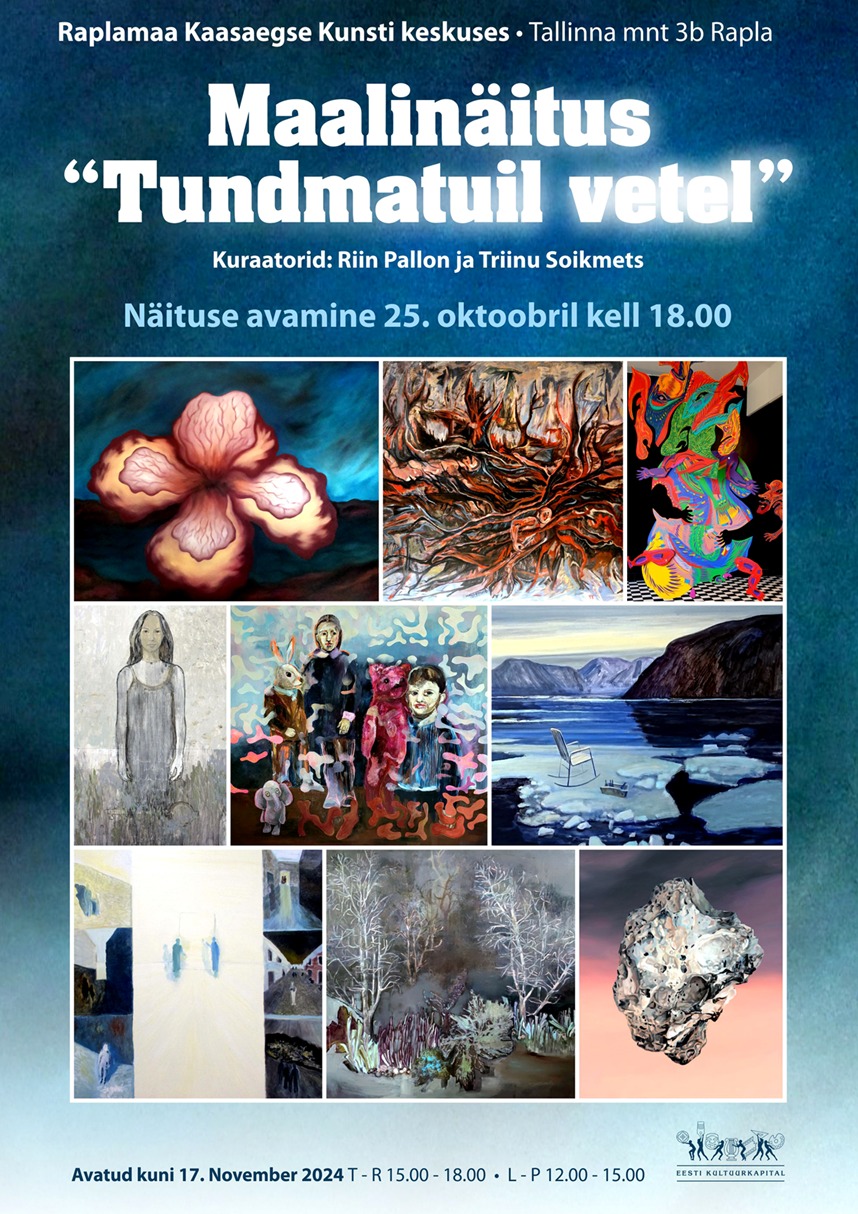
On Friday, October 25 at 18:00, the Rapla County Centre for Contemporary Art will open an exhibition of paintings titled “On Unknown Waters,” which focuses on the symbolism of water as a reflection of emotional states and diving beneath their surface, into the deep currents of the subconscious. The exhibition features nine contemporary artists, each of whom approaches the themes of the exhibition from their own angle.
In the paintings at the exhibition, there is a sense of enchantment – a delicate balancing act between beauty and nightmare, leading the viewer through the world of brushstrokes, where images and meanings reappear in ever new forms, carrying layers of symbols and hidden subtexts. For example, in dreams, a calm surface of water symbolises emotional balance, and a stormy sea symbolises anxiety, ice apathy and rain cleansing. In painting, water can take on other forms that are similar in appearance, while the search for this form, i.e. the painting process itself, can be equivalent to wandering and wandering through the landscapes of the soul and emotional fields.
The structure of the exhibition is divided into four rooms – “Layers of History”, “Spinning in the Subconscious”, “The Future Will Come Tomorrow” and “On Distant Waters” – to which additional nooks and crannies are added. Thus, a journey into the past, the journey of being human and the twists and turns of the subconscious, apocalyptic moods and utopias of the future, distant journeys and reflections of the world, but also water in the sense that it is one of our main components, making up two-thirds of the human body mass.
Riin Pallon’s paintings create tense atmospheres where the viewer finds themselves in a kind of dizzying state – looking for balance, but always stumbling a little. Her works are visual simulacrums where reality and illusion intertwine, giving way to new realities that constantly appear and disappear.
Manfred Dubov, on the other hand, relates to his starting point as a curator through the position that the painting reflects individual and collective life, such as genocide or post-pandemic tensions.
Eleriin Ello’s work is based on nature motifs and the states and shades of light and shadow in such a way that even the meteoritic chunks of rock in her paintings seem delicate and sensitive.
Marta Stratskas contrasts her with psychological portraits and surreal figures in a colourful series that deals with a sense of family togetherness and love.
Leho Rubis’s figures, on the other hand, are solitary and separate, and even more restrained in colouring, speaking of consciousness and the field of perception, the poetry and reflections of the inner world, foggy landscapes and darkness during the day.
Jenny Grönholm’s paintings do not exude light either, but only an all-encompassing glow, against the background of which the figures alternately emerge and disappear – a symbolic circle of self-discovery.
The symbolism of Miina Barrera Pinochet, in turn, compares the clearing to the complexity of the human soul, rooting in a foreign landscape to the process of purification, and the atmosphere to social relations.
Kalli Kalde deals with the theme of water, i.e. the most direct of the exhibition artists, depicting human figures with aquatic animals and birds in all possible shades of the big blue.
Finally, Maria-Kristiina Ulas goes beyond the expected standard of painting, i.e. the square canvas on the wall. For example, her plywood figure, sawn into the shape of a laughing Buddha, deals with the issues of the soft, proliferating human form, self-care, the birth of a new life and the generation of ideas.
Curators: Riin Pallon, Triinu Soikmets
Poster: Indrek Tuuga/Adograaf